
The Wounds That Glowed
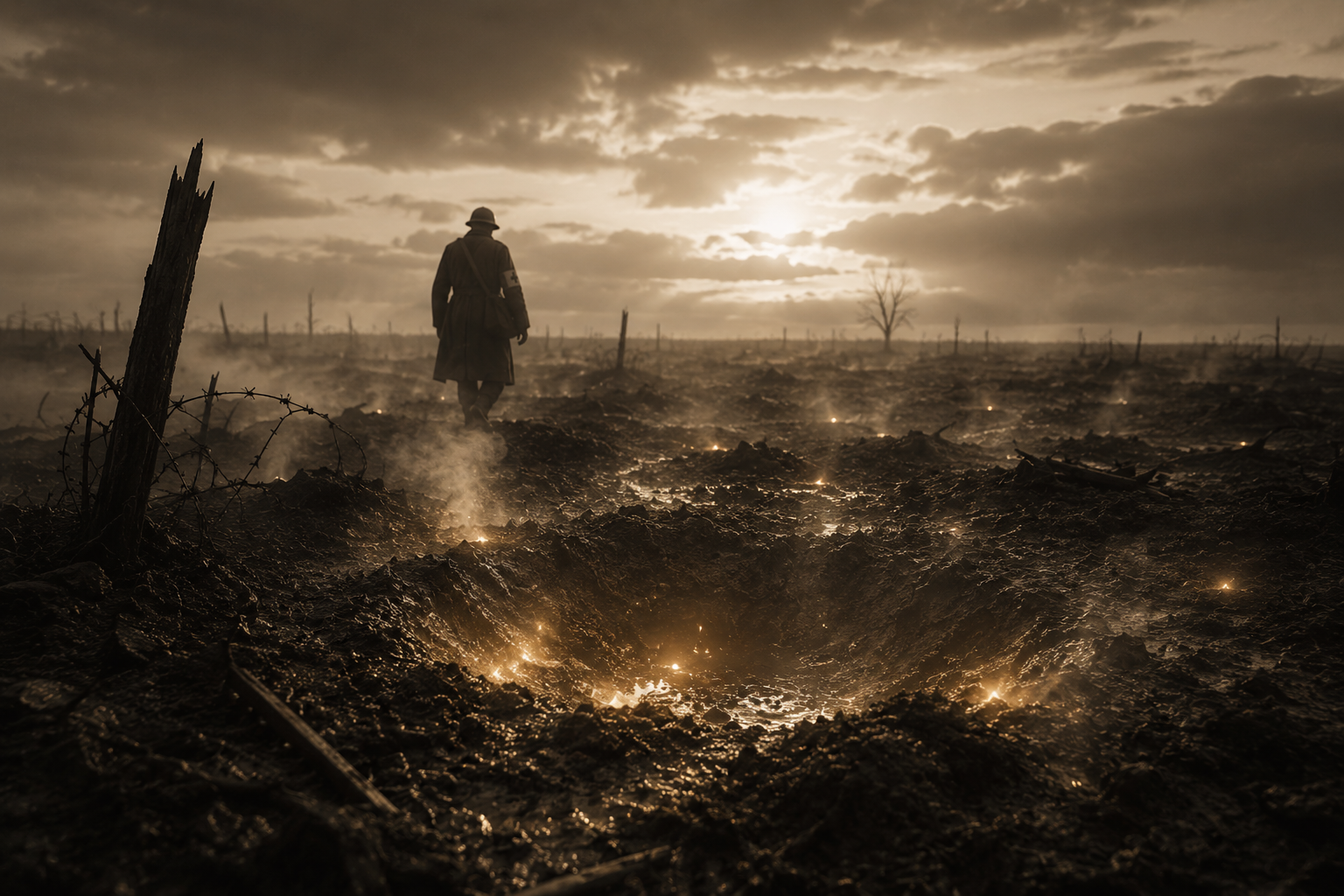
On the night after the Battle of Shiloh, something strange was reported among the wounded. Men lying in the darkness appeared to give off a faint blue-green glow around their injuries. Stranger still, some of those glowing wounds seemed to heal better than the others.
For more than a century, the story sat in the uneasy space between battlefield folklore and unexplained history. Then two teenagers decided to test whether the glow might have had a scientific cause.
THE NIGHT AFTER SHILOH
By the evening of April 7, 1862, the fighting around Shiloh Church had ended. The battlefield was crowded with wounded men, many of whom remained outside through a cold, wet night while overwhelmed medical teams struggled to reach them.
According to the later story, some soldiers noticed an eerie light around their wounds. The glow was described as blue-green, faint but visible in the darkness. The men whose injuries glowed were said to have survived more often and recovered more cleanly than those whose wounds did not.
The phenomenon eventually acquired a name: Angel’s Glow.
WHAT HISTORY CAN ACTUALLY PROVE
The Battle of Shiloh is well documented. The glowing wounds are not.
No known contemporary medical report clearly records soldiers shining in the dark, and the familiar version of the story appears to have circulated much later. That does not make it impossible. It means the evidence is thinner than the legend.
This distinction matters. The most interesting explanation does not require pretending the story is better documented than it is. It only asks whether the reported conditions could have produced the effect described.
THE BACTERIUM THAT GLOWED
The leading explanation centers on Photorhabdus luminescens, a bacterium that lives inside tiny parasitic worms called nematodes. The bacteria produce a blue-green light and help the worms kill insects underground.
Under ordinary conditions, the human body is too warm for the bacterium to survive. But the soldiers at Shiloh had spent hours in cold rain and mud. Some were reportedly hypothermic. Their body temperatures may have dropped low enough for the bacteria to remain alive in their wounds.
If that happened, the bacteria may also have suppressed other microbes that would normally cause infection. The glow would not have healed the wounds by magic. It may have been a visible side effect of an unusual biological defense.
TWO STUDENTS ASKED A SIMPLE QUESTION
In 2001, Bowie High School students Bill Martin and Jonathan Curtis investigated whether the old battlefield legend might have a biological explanation. They worked with researchers at the USDA Agricultural Research Service Plant Science Institute, including microbiologist Phyllis Martin, who had previously studied Photorhabdus luminescens as a possible biological pest-control agent.
Their project examined whether the bacterium’s glow and antimicrobial activity could explain the later accounts. They found that three Photorhabdus strains produced antibiotics capable of inhibiting other bacteria that could cause infection in open wounds.
The work earned first place in team competition at the 2001 Intel International Science and Engineering Fair. It did not prove that the reported glow occurred at Shiloh. It showed that a real bioluminescent bacterium possessed a property that could help explain why glowing wounds were later associated with better healing.
THE TEST
Question
Could the bacteria survive in conditions like those reported at Shiloh?
Result
Cold conditions made the proposed mechanism biologically plausible.
Limit
The experiment did not prove that the battlefield accounts happened exactly as remembered.
After hearing the legend of Angel’s Glow during a visit to Shiloh, Bill Martin asked his mother, USDA microbiologist Phyllis Martin, whether the glowing bacteria she studied could explain the story.
She didn’t give him the answer.
She encouraged him to test the idea. That conversation led Bill Martin and Jonathan Curtis to investigate the legend through experiments of their own.
seekmore
DID ANGEL'S GLOW REALLY HAPPEN?
History cannot answer that with certainty.
The Battle of Shiloh unquestionably happened. Cold rain, mud, and thousands of wounded soldiers left overnight on the battlefield are well documented.
The glowing wounds are different. Most surviving descriptions appeared decades later rather than in medical records written during the battle itself. That means historians cannot confidently say the phenomenon occurred exactly as it has been remembered.
Yet the lack of direct evidence does not automatically make the story false. Memories can preserve real events while changing details over time. Legends sometimes grow around a small truth.
What makes Angel’s Glow remarkable is not that science proved the legend. It is that science showed the legend was possible.
For more than a century, people dismissed the story because it sounded impossible. Then two students asked whether biology might explain it. They didn’t prove the glow. They removed the biggest reason for rejecting it.
Sometimes that’s how history moves forward, not by replacing mystery with certainty, but by replacing impossibility with plausibility.
WHY THIS STORY STILL MATTERS
Angel’s Glow isn’t just a story about a Civil War battlefield. It’s a reminder that evidence changes. Assumptions change. Questions change.
For generations, the story lived in the space between folklore and science. Neither side had enough information to explain it completely. Then someone asked a better question.
The IT File exists because history is full of stories like this. Stories where certainty arrived too early, where dismissal became habit, or where the smallest overlooked detail changed everything.
Sometimes the truth isn’t buried because someone hid it. Sometimes it simply hasn’t been looked at from the right angle yet.
What is documented
The Battle of Shiloh was fought April 6–7, 1862, and caused 23,746 killed, wounded, or missing.
Photorhabdus luminescens is bioluminescent, lives in association with nematodes, and produces antimicrobial compounds.
Martin and Curtis proposed the connection in an award-winning 2001 science project.
What remains uncertain
Whether wounded soldiers at Shiloh visibly glowed as later stories describe.
Whether P. luminescens was actually present in those wounds.
How much of the familiar account is contemporary evidence versus later folklore.