Grace O’Malley: Case File 01
The IT File / Other Female Pirates / File 01
Gráinne Ní Mháille Grace O’Malley
The Gaelic Sea-Woman Who Ruled Before the Pirate Queen Myth
Where official reports end, my work begins. — Lanara Tala
Quick Answer
She existed. She commanded at sea. She negotiated with Tudor officials. Her 1593 approach to Elizabeth I is documented. But the familiar red-haired Pirate Queen — cutting off her hair, refusing to bow, speaking Latin, carrying a dagger into court — is a later composite in which records and folklore are repeatedly presented as equals.
The strongest evidence places Gráinne Ní Mháille within the political and maritime world of sixteenth-century Connacht: a Gaelic noblewoman, landholder, shipowner and sea captain whose family drew power from coastlines, islands, trade, tribute, armed force and alliance. English officials could describe the same activity as rebellion or piracy.
The First Mystery: Her Name
Contemporary English records rendered her name in many forms, including Grace Imallye and Grany O’Mally. Modern usage alternates among Gráinne Ní Mháille, Gráinne Mhaol, Granuaile and Grace O’Malley. The popular explanation that Mhaol means she was bald after cutting her hair is attractive folklore, but it should not be treated as a secure biographical event.
Before the Legend
Born about 1530 into the Ó Máille lordship of Umhaill in County Mayo, she belonged to a seafaring political culture rather than a modern nation-state. The family operated in and around Clew Bay. Her father’s name is usually given as Eoghan Dubhdarra Ó Máille. No contemporary portrait of Gráinne is known.
What Did She Actually Rule?
Calling Gráinne a pirate is not wholly invented, but it is incomplete. Her authority combined kinship, land, vessels, fighting men, coastal strongholds, marriage alliances, toll-taking, trade and raiding. Those activities existed within Gaelic lordship while the expanding Tudor state increasingly claimed the right to classify, regulate and punish them.
The careful distinction is therefore not pirate versus innocent. It is between a modern romantic pirate identity and a documented regional leader whose maritime power could be commercial, political and coercive at the same time.
Marriage, Alliance and Power
Her first marriage was to Dónal an Chogaidh Ó Flaithbheartaigh. She later married Risdeárd an Iarainn Bourke, known in English as Richard-in-Iron Burke. These marriages connected her to powerful Connacht families, but surviving records do not reduce her to either husband’s dependent. She appears as a political actor in her own right.
1577 — The Famous Sea Captain
Sir Henry Sidney’s account of meeting her is among the clearest contemporary descriptions. He called her a famous female sea captain and recorded that she offered service with three galleys and two hundred fighting men. The report matters because it documents both reputation and usable military capacity — while still filtering her through an English official’s words.
The Piracy Label Problem
English records sometimes frame her as a rebel, spoiler or pirate. Those terms reveal acts attributed to her, but also the Crown’s political viewpoint. Demanding payment from ships, carrying armed followers and resisting officials could be understood locally as lordship and protection, while Tudor administrators treated them as unlawful exactions and defiance.
1593 — The Woman Who Went to Greenwich
By 1593 Gráinne was in her sixties and under severe pressure from Sir Richard Bingham, the English governor of Connacht. Members of her family had been imprisoned and her economic position damaged. Instead of remaining inside a regional conflict, she carried her case toward the center of Tudor power.
The Eighteen Questions
Before the audience, eighteen written interrogatories established her kin, marriages, children, property and circumstances. These articles are among the most valuable surviving anchors for her biography. They were created for an English administrative purpose, however, and are neither a neutral autobiography nor a transcript of private conversation.
The Meeting with Elizabeth I
The audience at Greenwich in 1593 is documented. Gráinne petitioned for relief and made political promises; Elizabeth’s government directed that certain imprisoned relatives be released and that measures be taken concerning the family’s lands and maintenance. Implementation remained contested in Ireland.
What the Record Does Not Secure
Did She Defeat the Queen?
No. She made a calculated appeal inside the Tudor system while preserving as much family power as circumstances allowed. Elizabeth did not recognize a second sovereign queen. But Gráinne was not simply dragged to court and silenced. She negotiated.
Evidence Matrix
Documented
Gráinne Ní Mháille existed; belonged to the Ó Máille political and maritime world; married into the Ó Flaithbheartaigh and Bourke families; controlled vessels and armed followers; was recognized by English officials as a sea captain and regional power; interacted with Sir Henry Sidney; came into sustained conflict with Sir Richard Bingham; answered eighteen interrogatories; petitioned the Tudor court; met Elizabeth I in 1593; received written Crown intervention; continued negotiating over family property and political survival.
Plausible
She learned maritime practice within her family; exercised authority through personal ability as well as kinship; combined trading, toll-taking, raiding and protection; understood English political procedure well enough to exploit divisions between local officials and the royal court; inspired long-lived oral tradition in western Ireland.
Speculative / Disputed
Exact birth date; exact size and continuous composition of her fleet; precise personal role in every raid later assigned to her; the hair-cutting origin story; giving birth aboard ship and immediately fighting; the Howth abduction story as a literal event; dagger and refusal-to-bow scenes; a Latin conversation with Elizabeth; detailed private dialogue between the two women.
Unknown
Her own words beyond answers and petitions prepared through Tudor documentary systems; her appearance; the full economic organization of her maritime network; how authority was divided among kin and captains; the precise place and date of death; the degree to which later folklore preserves lost events rather than later invention.
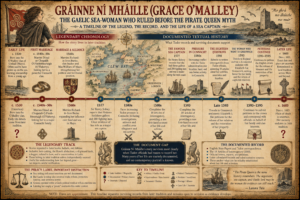
Two-Track Timeline
| Date | Track | Event / Assessment |
|---|---|---|
| c. 1530 | Biography | Birth in the Ó Máille lordship — approximate; childhood details are largely reconstructed. |
| c. 1540s-50s | Documented frame | Marriage to Dónal an Chogaidh Ó Flaithbheartaigh; exact domestic chronology varies. |
| 1560s | Documented frame | Marriage to Richard-in-Iron Bourke strengthens connections in Mayo. |
| 1577 | Documented | Sir Henry Sidney records the “famous” female sea captain with three galleys and 200 fighting men. |
| 1580s | Documented | Conflict intensifies as Tudor administration expands in Connacht; Bingham becomes central adversary. |
| 1593 | Documented | Interrogatories, petitions and journey to court; audience with Elizabeth I at Greenwich. |
| 1593-95 | Documented | Royal directions encounter resistance; Gráinne continues petitions and negotiations. |
| c. 1603 | Biography | Frequently reported death year; exact date and place remain uncertain. |
| Later tradition | Legend | Howth, hair-cutting, shipboard birth, dagger and no-bow narratives become central to the public figure. |
Timeline rule: Dates drawn from administration and correspondence receive the documentary track. Stories first secure in later tradition remain on the biography/legend track even when they may contain a historical echo.
Map Plate — Historical Reconstruction Plan
The historical map will center on Clew Bay and western Connacht. It will mark Clare Island, Achill Island, Rockfleet (Carraigahowley), Burrishoole, Westport, Galway, the Mayo coastline and the approaches into the Atlantic. A wider inset will connect western Ireland with Dublin and Greenwich.
Solid lines will be reserved for documented journeys or political connections. Dashed lines will show plausible maritime corridors. Shaded water will indicate the approximate sphere associated with Ó Máille maritime power. No decorative route will be presented as a documented voyage.
Map II — The Same Coast Today
The modern locator map will show County Mayo, Clew Bay, Clare Island, Achill, Newport, Westport and Galway, with a Britain inset locating Greenwich/London. Its purpose is to make the distance, coastline and island geography immediately legible.
Questions in the Margin
- What survives in the original interrogatories that later summaries omit?
- Which raids or exactions can be tied to contemporary documents?
- How did Gaelic maritime tribute work in practice?
- What authority was hers personally, and what belonged to clan and marriage networks?
- When do the Howth, hair-cutting, dagger and Latin stories first appear in writing?
- Can local oral traditions be dated through Ordnance Survey letters or earlier collections?
- What did Elizabeth’s orders actually change on the ground?
- When did the chieftain and sea captain become the modern Pirate Queen?
Pattern Under Review
Women who operate inside systems of force are often simplified twice: first by hostile officials, then by admiring storytellers. Tudor records turned Gráinne into a problem to administer. Later culture turned her into a symbol of fearless independence. Both views preserve something; neither is the entire woman.
Lanara’s File Note
The legend gives her a blade, a storm and a queen who could be stared down. The record gives us something harder to romanticize — and more impressive.
It gives us a woman who understood ships, kinship, property and power. A woman who survived between a Gaelic order under pressure and a Tudor state learning how to reach the western coast. When local authority closed around her family, she did not wait for the story to rescue her. She crossed the water and entered the machinery herself.
The Pirate Queen is the name history remembers. The negotiator, sea captain and Gaelic lord may be the woman the evidence can still reach.
Source Trail
Primary documentary anchor: The eighteen Articles of Interrogatory and related State Papers for Ireland, 1593-1595, preserved through the UK National Archives and calendared State Papers. These records should remain the controlling evidence for the Greenwich episode and Crown response.
Irish biographical authority: Mary O’Dowd, “O’Malley, Gráinne (Grace) (Granuaile),” Dictionary of Irish Biography, Royal Irish Academy. Read the biography.
Archive interpretation: The National Archives (UK), “Meeting Grace O’Malley, Ireland’s pirate queen.” Read the archive article.
Maritime legend audit: Royal Museums Greenwich, “Grace O’Malley, fact and fiction.” Read the legend audit.
Major modern biography: Anne Chambers, Grace O’Malley: The Biography of Ireland’s Pirate Queen, 1530-1603 (revised editions). Valuable for assembling dispersed manuscripts; individual claims should still be traced to the cited record.
Public-history context: Galway City Museum, “Gráinne Ní Mháille: The Woman Behind the Legend.” View the museum program.
Next production stage: historical timeline image + Clew Bay reconstruction map + modern locator map.