THE LIVING RECORD
THE IT FILE
No file sits alone
CLEMENCY · MEMORY · ACCOUNTABILITY · HUMAN CONSEQUENCE
Pardon Me
Reconciliation is a beautiful word.
It becomes something else when the first story is left outside.
QUESTIONS IN THE FILE
Start with the question that did not disappear.
QUICK ANSWER
What Pattern Can Appear After Political Violence, Trials, and Pardons?
After violence, a second public story can begin. The first story asks what happened, who was harmed, and who was held responsible. The second story often asks whether punishment has gone too far, whether the convicted were treated unfairly, or whether clemency is needed for healing.
Oradour-sur-Glane shows how painful that shift can be. Four days after D-Day, Waffen-SS troops murdered 642 people in a French village. Years later, only a small number of perpetrators were tried, and much of the punishment was reduced, pardoned, or erased. The ruins remained. The sentences did not.
THE FIRST STORY
Who was harmed?
The first record is the dead, the survivors, the ruins, and the ordinary village day that was torn open.
THE SECOND STORY
Was punishment too much?
After trial comes a different public language: pity, unfairness, healing, clemency, and national repair.
THE PATTERN
The center moves
The file follows the shift between who was harmed and how long the punished should stay punished.
FIRST WOUND
June 6, 1944: The Landing
On June 6, 1944, Allied forces landed in Normandy.
D-Day had begun.
For occupied France, liberation no longer lived only as rumor. It had a coastline. It had ships. It had soldiers. It had a date.
But liberation did not arrive everywhere at once.
Oradour-sur-Glane was not on the beach. It was not a battlefield. It was not the kind of place most people imagine when they picture history arriving with a map in its hand.
It was a village.
There were schools. Shops. Families. Children. People with chores, errands, meals, unfinished conversations, and ordinary fears that continued even under occupation.
Four days after D-Day, the war had shifted. Oradour did not know it was about to become a place where the war stopped pretending it had rules.
THE ORDINARY DAY
June 10, 1944
June 10 was a Saturday.
That detail matters because ordinary days are where horror hides before it enters.
The people of Oradour were not gathered for battle. Children were not soldiers. Women were not combatants. Men were not standing in formation as an army.
The day had the shape of village life.
A person could wake up thinking about bread. A child could think about school. A parent could think about dinner. A shopkeeper could think about the next customer.
Then the SS arrived.
Troops from the Waffen-SS division Das Reich entered Oradour-sur-Glane. The village was sealed off. People were rounded up. Men were separated from women and children.
The men were taken to barns and other buildings.
The women and children were taken to the church.
The machinery of murder often begins with sorting.
The Barns
The men were shot.
Not in the chaos of battle. Not as crossfire from a moving front line. They were gathered and killed. Some were wounded first, then burned when buildings were set on fire.
A few survived by hiding beneath bodies or escaping through flames and smoke.
Most did not.
The village had been turned into a map of locked exits.
The Church
The women and children were inside the church.
The church should have meant shelter.
That is part of the cruelty. The place associated with candles, baptisms, mourning, weddings, quiet, and refuge became the place where hundreds were trapped.
The SS placed a smoke-producing or explosive device inside, then fired into the church and set it ablaze. Only one woman, Marguerite Rouffanche, survived from inside the church. She escaped through a window and was wounded.
The rest were left inside a building people had once entered to pray.
WHAT WAS LEFT
The Village Became Evidence
By the end of the day, Oradour-sur-Glane was no longer a village in the ordinary sense.
It was evidence.
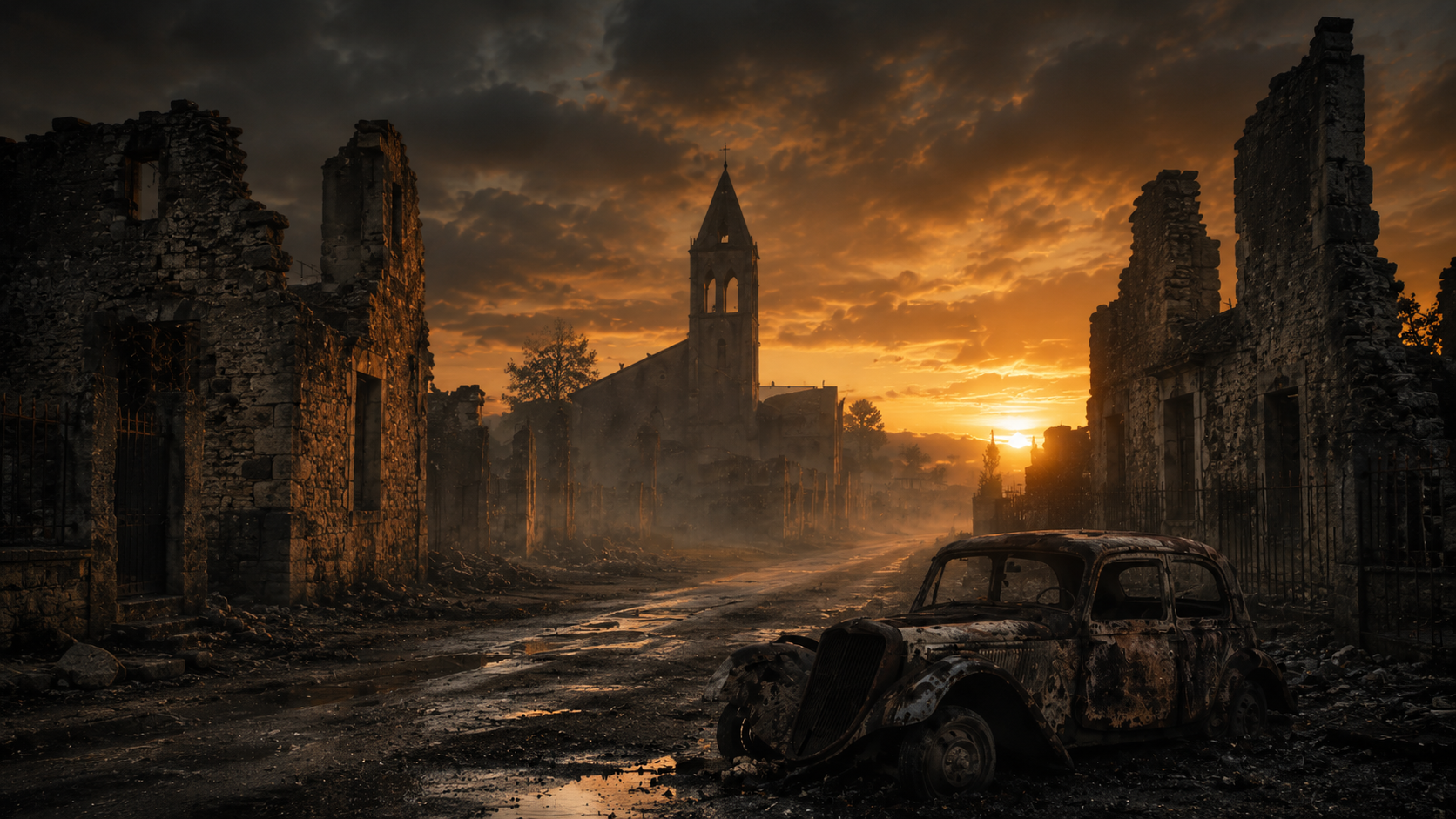
Homes burned. Shops burned. The church burned. Cars remained where people had left them. The streets kept the shape of life, but the life had been removed.
642 men, women, and children were murdered.
The dead included schoolchildren.
That is why the ruins matter. The ruins are not scenery. They are not a dramatic backdrop for history tourism. They are the physical refusal to let the second story erase the first.
PATTERN UNDER REVIEW
The Second Wound
If the story ended there, it would already be unbearable.
But it did not end there.
After war comes paperwork.
Investigations. Trials. Defenses. Sentences. Appeals. Political pressure. Public arguments over who deserves punishment, who deserves pity, and who must be included in the language of national repair.
In 1953, a trial was held in Bordeaux. Only a small number of men were tried in person.
Some of the defendants were Alsatians who argued that they had been forcibly conscripted into German military service after Nazi Germany annexed Alsace. That was a real complication. The phrase often used for these men was malgré-nous, meaning “against our will.”
A serious justice system should be able to hold complexity.
But what followed did not feel like justice to the families of Oradour.
Several men were convicted. Some received prison sentences. Death sentences were imposed. Then came amnesty, pardons, commutations, and release.
Within a few years, the men tried in person were free.
The village remained ruined. The dead remained dead. The official need became reconciliation. The surviving families were left with the part of reconciliation that had no ceremony.
THE COST
What Reconciliation Cost
Reconciliation is not an ugly word.
It can be necessary. It can be brave. It can keep a country from tearing itself apart.
But reconciliation changes shape when the people harmed are not the center of it.
At Oradour, the state had a problem larger than one trial. France had to live with occupation, collaboration, forced conscription, regional pain, and national rebuilding. Alsace had its own wound. Limousin had its own dead.
There was no simple national story.
That is why the case matters. Not because it removes complexity, but because it shows what can happen when complexity becomes the doorway through which consequence leaves.
PATTERN DETECTED
The Story Shifts
This file does not decide who the reader should see as victim, villain, or something more complicated.
It follows the movement of the story.
First, public attention centers on what happened and who was harmed. Later, attention may move toward whether punishment was too harsh, whether the convicted were treated unfairly, whether the country needs healing, or whether accountability is reopening old wounds.
Some of those questions may be fair.
But when they replace the original question entirely, something changes.
The original question was: Who was harmed?
The later question becomes: How long should the punished remain punished?
The space between those questions is where this file is looking.
The Pattern Did Not Stay in France
Oradour is not the same as modern political violence. The scale, setting, crimes, and history are different. Flattening them into one category would erase too much.
The comparison here is narrower.
It is about the second public story that can follow violence: the story told after records exist, after courts act, after punishment begins, and after political language starts to rearrange the center of attention.
CAREFUL COMPARISON
Example: January 6, 2021
On January 6, 2021, the United States Capitol was attacked as Congress met to certify the 2020 presidential election.
According to Department of Justice summaries before the mass clemency, roughly 1,600 people had been charged in connection with the attack. More than 140 law enforcement officers were reported injured.
One rioter, Ashli Babbitt, was fatally shot by Capitol Police while attempting to breach the Speaker’s Lobby. Several other people died during or shortly after the attack. Officer Brian Sicknick died the next day after suffering strokes, and multiple officers who responded later died by suicide.
Then came the second story.
On January 20, 2025, President Donald Trump issued sweeping pardons and commutations for January 6 defendants. The White House proclamation described the prosecutions as a “grave national injustice” and said the action would begin a “process of national reconciliation.”
That wording belongs in the record because it shows the official frame. Supporters described the pardons as a correction to politicized prosecutions. Critics described them as an abandonment of accountability. Court records, news reports, and government pages preserve the underlying numbers, charges, sentences, and injuries.
The point is not to ask the reader to accept one frame first.
The point is to notice the shift between frames.
When a legal consequence is later described as the injustice, what happens to the people harmed in the first story?
Claims, Settlements, and the New Center
In 2025, multiple outlets reported that the Trump administration agreed to pay nearly $5 million to settle a wrongful-death lawsuit brought by Ashli Babbitt’s estate. In 2026, the Justice Department announced an anti-weaponization fund, and Reuters later reported that Trump allies were pursuing alternate compensation paths for people who claimed they were targeted by politicized prosecutions, including January 6 defendants.
This is where the public story becomes harder to map in a single sentence.
There are pardons. There are lawsuits. There are claims of unfair prosecution. There are officers and prosecutors who say the record should not be erased. There are supporters who say the record was political from the start.
FIELD NOTES
Why This File Starts With the Village
The ruins of Oradour-sur-Glane remain because someone understood that memory needs a body.
A wall. A street. A burned car. A church.
A place where the sentence “this happened” cannot be softened too quickly into “it was complicated.”
Because it was complicated.
Occupation was complicated. Forced conscription was complicated. National rebuilding was complicated. Reconciliation was complicated.
But the children in the church were not an abstraction.
The families waiting for justice were not an abstraction.
And the question of what a country does with its dead after the paperwork begins is not only legal.
It is human.
A pardon can empty a prison cell. It cannot unburn a church.
OPEN OTHER FILES IN THE PATTERN TRAIL
CONNECTED FILES
Not the Same. Still Nearby.
These examples are not identical. They should not be treated as interchangeable. They appear because each one shows a different point where harm, record, punishment, mercy, and public narrative intersect.
OPEN THE SOURCE TRAIL
SOURCE TRAIL
Sources and Reference Trail
Start with the public record. Follow the receipts.