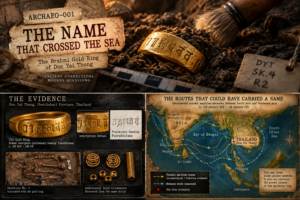
The Name That Crossed the Sea
ARCHAEO DIVISION // FIELD RECORD 001
The Name That Crossed the Sea
The Brahmi Gold Ring of Don Yai Thong
OPEN INVESTIGATION
Location: Don Yai Thong, Phetchaburi Province, Thailand
Period: Late Prehistoric / Early Historic transition
Approximate date: c. 100 BCE–100 CE
Primary artifact: Gold ring bearing a Brahmi inscription
Associated burial: Skeleton No. 4
A gold ring. An ancient name. A grave in Thailand. And evidence of a world that may have been far more connected than the map suggests.
QUICK ANSWER
About two thousand years ago, someone was buried at what is now Don Yai Thong in western Thailand. Among the objects associated with the burial was a small gold ring. The gold alone would have made the discovery notable. The writing changed the story.
Cut into the ring is an inscription identified preliminarily as Brahmi, an ancient South Asian writing tradition. Reporting on the excavation gives a reading approximately rendered as Pusrakhitasa, potentially connecting the object with a personal name. The discovery does not establish that the buried individual was Indian, nor that the individual was a merchant. What it does provide is a physical object linking a burial in ancient Thailand with a South Asian writing tradition and the wider networks through which people, objects and ideas moved.
THE DISCOVERY
The Don Yai Thong archaeological site in Phetchaburi Province contains ancient burials and grave goods that help illuminate communities living in the region roughly two millennia ago. During excavation work in 2026, archaeologists reported gold rings associated with Skeleton No. 4, including an inscribed example. Specialists connected the writing with Brahmi and placed the find broadly within the period of expanding contact between South and Southeast Asia.
EVIDENCE STATUS: DOCUMENTED
THE PERSON IN THE GRAVE
The association with Skeleton No. 4 is crucial because the ring has archaeological context rather than being an unprovenanced antiquity. Follow-up reporting described additional gold ornaments from the burial. These objects can reasonably support an investigation of status and access to prestige goods, but they do not by themselves establish royalty, occupation, caste, ethnicity or birthplace.
The safest current description is: a person buried with objects reflecting wealth, status and/or participation in wider exchange networks.
EVIDENCE STATUS: DOCUMENTED / INTERPRETATION PLAUSIBLE
THE NAME
The preliminary reading reported for the inscription is approximately Pusrakhitasa. Published interpretations have connected it with the personal name Pusrakhita and an ownership construction – roughly, "of/belonging to Pusrakhita." Interpretations remain subject to specialist epigraphic study.
Even if the reading is confirmed, an inscription identifying an owner does not automatically identify the person in the grave. The ring could have been owned, inherited, exchanged, gifted or otherwise transferred.
EVIDENCE STATUS: PRELIMINARY READING DOCUMENTED / IDENTITY UNKNOWN
FOLLOWING THE BRAHMI TRAIL
Brahmi is foundational to the history of writing in South Asia and to later scripts across much of Asia. The Don Yai Thong ring is especially interesting because other early Brahmi-inscribed objects are known from Thailand. Peer-reviewed scholarship has examined inscribed seals and beads from southern Thailand as evidence relevant to early South Asia-Southeast Asia contact.
That makes ARCHAEO-001 part of a larger archaeological pattern rather than a sensational one-off discovery.
EVIDENCE STATUS: DOCUMENTED
ACROSS THE BAY OF BENGAL
During the final centuries BCE and opening centuries CE, maritime exchange linked communities around the Bay of Bengal, Indian Ocean and Southeast Asian coasts. Goods moved through these systems, but so did sailors, traders, craftspeople, religious specialists, languages, scripts, technologies and personal identities.
The exact journey of this particular ring is unknown.
THE MERCHANT HYPOTHESIS
Some early interpretations have associated the ring and related evidence with merchant activity. That is worth investigating because merchants were important participants in ancient maritime exchange, and inscribed seals can have commercial functions. But the available evidence does not establish Skeleton No. 4's profession or caste.
Merchant: PLAUSIBLE. Merchant caste proven: NO. Indian origin of Skeleton No. 4: UNKNOWN.
THE 'INDIANIZATION' QUESTION
Older scholarship often used "Indianization" to describe the spread of South Asian scripts, religions, political concepts and material culture into Southeast Asia. The term can be useful historically, but it can also suggest an overly simple one-way transfer. Current archaeological interpretation gives greater attention to Southeast Asian agency: communities selected, adapted and transformed incoming ideas and objects.
The Brahmi ring is therefore evidence of connection. It is not, by itself, evidence that one civilization simply replaced another.
WHAT THE RING SUPPORTS
DOCUMENTED: A gold ring with a Brahmi inscription was reported from the Don Yai Thong excavation in association with Skeleton No. 4. Additional gold ornaments were reported from the burial. Comparable early Brahmi-inscribed artifacts are known in Thailand. Wider archaeological evidence supports South Asia-Southeast Asia maritime interaction during the period.
UNKNOWN: The birthplace and ancestry of Skeleton No. 4; whether the inscribed name belonged to the deceased; the ring's manufacturing location; whether it was inherited or exchanged; the exact route by which it reached Don Yai Thong.
QUESTIONS IN THE MARGIN
01 – Was Skeleton No. 4 local? Isotopic study may help investigate mobility if suitable material and comparative baselines are available.
02 – Can ancient DNA add context? Potentially, if preservation and sampling allow reliable analysis.
03 – Where did the gold originate? Compositional analysis may characterize the material, though exact provenance can be difficult to establish.
04 – Where was the ring manufactured? Manufacturing traces and comparative typology could help.
05 – Was Pusrakhita the person in the grave? Still unknown.
06 – Was it actually used as a seal? Wear, design and surviving impressions could be informative.
07 – What do the surrounding burials reveal? Cemetery context may ultimately be more informative than the ring alone.
THE HUMAN SIDE
Strip away the terminology for a moment. Someone owned this ring. Someone knew the name cut into its surface. Perhaps it was worn daily. Perhaps it was a marker of identity, a gift, an inheritance or a tool. Then the object entered a grave in what is now Thailand.
Two thousand years passed. Landscapes changed. Kingdoms appeared and disappeared. Yet characters scratched into gold remained long enough to be read again.
PATTERN UNDER REVIEW
ARCHAEO-001 joins evidence showing that ancient Southeast Asia was not an isolated destination waiting to be "discovered." It participated in dynamic regional and maritime worlds. The pattern includes scripts, seals, beads, metalwork, religious transmission, maritime technology and people whose lives crossed boundaries that modern maps make look much more rigid.
The better question is not simply, Did India reach Southeast Asia?
Who was moving between these worlds – and what happened when they arrived?
FIELD NOTE // LANARA TALA
The temptation with an artifact like this is to make it tell us more than it can. An Indian-derived script does not make an Indian skeleton. Gold does not make a king. Trade does not require conquest.
But neither should we minimize the discovery. A South Asian writing tradition appears on gold recovered from an ancient burial in Thailand. That is a connection worth following.
Maybe a merchant. Maybe a traveler. Maybe a local elite participating in distant networks. Maybe generations of families whose identities no longer fit neatly on either side of the Bay of Bengal.
For now, the grave keeps that part of the story.
But it gave us the name.
– Lanara Tala Where official reports end, my work begins.
SOURCE TRAIL & READING LIST
Fine Arts Department of Thailand – Official/institutional reporting on the Don Yai Thong archaeological site and additional gold objects from the burial.
https://www.finearts.go.th/
Khaosod English – English-language reporting on the July 2026 discovery and preliminary interpretation of the inscribed ring.
https://www.khaosodenglish.com/featured/2026/07/03/ancient-inscribed-gold-ring-found-at-phetchaburi-site/
Thai PBS – Follow-up reporting concerning additional gold ornaments associated with Skeleton No. 4.
https://www.thaipbs.or.th/
Wongsathit, U-tain; Mangmeesukhsiri, Sombat; Khatshima, Kangvol. "Epigraphs on Seals in Southern Thailand: Concrete Evidence of India's Earliest Contact with Suvarnabhumi." Journal of Language and Culture 42(2), 2023.
https://so03.tci-thaijo.org/index.php/JLC/article/view/274313
Boonyarit Chaisuwan. "Early Contacts between India and the Andaman Coast in Thailand from the Second Century BCE to Eleventh Century CE," in Early Interactions between South and Southeast Asia, ed. Pierre-Yves Manguin, A. Mani and Geoff Wade.
Sila Tripati. "Seafaring Archaeology of the East Coast of India and Southeast Asia during the Early Historical Period." Ancient Asia 8 (2017).
Richard Salomon. Indian Epigraphy: A Guide to the Study of Inscriptions in Sanskrit, Prakrit, and the Other Indo-Aryan Languages.
Himanshu Prabha Ray. The Archaeology of Seafaring in Ancient South Asia.
Pierre-Yves Manguin, A. Mani & Geoff Wade, eds. Early Interactions between South and Southeast Asia.
John Guy. Lost Kingdoms: Hindu-Buddhist Sculpture of Early Southeast Asia.