THE LIVING ARCHIVE
THE IT FILE
The patterns emerge between the points.
IDENTITY · CLASSIFICATION · ARTIFICIAL INTELLIGENCE · HUMAN CONSEQUENCE
Define: Human
A machine can imitate a face.
The harder question is who gets to decide what the face is worth.
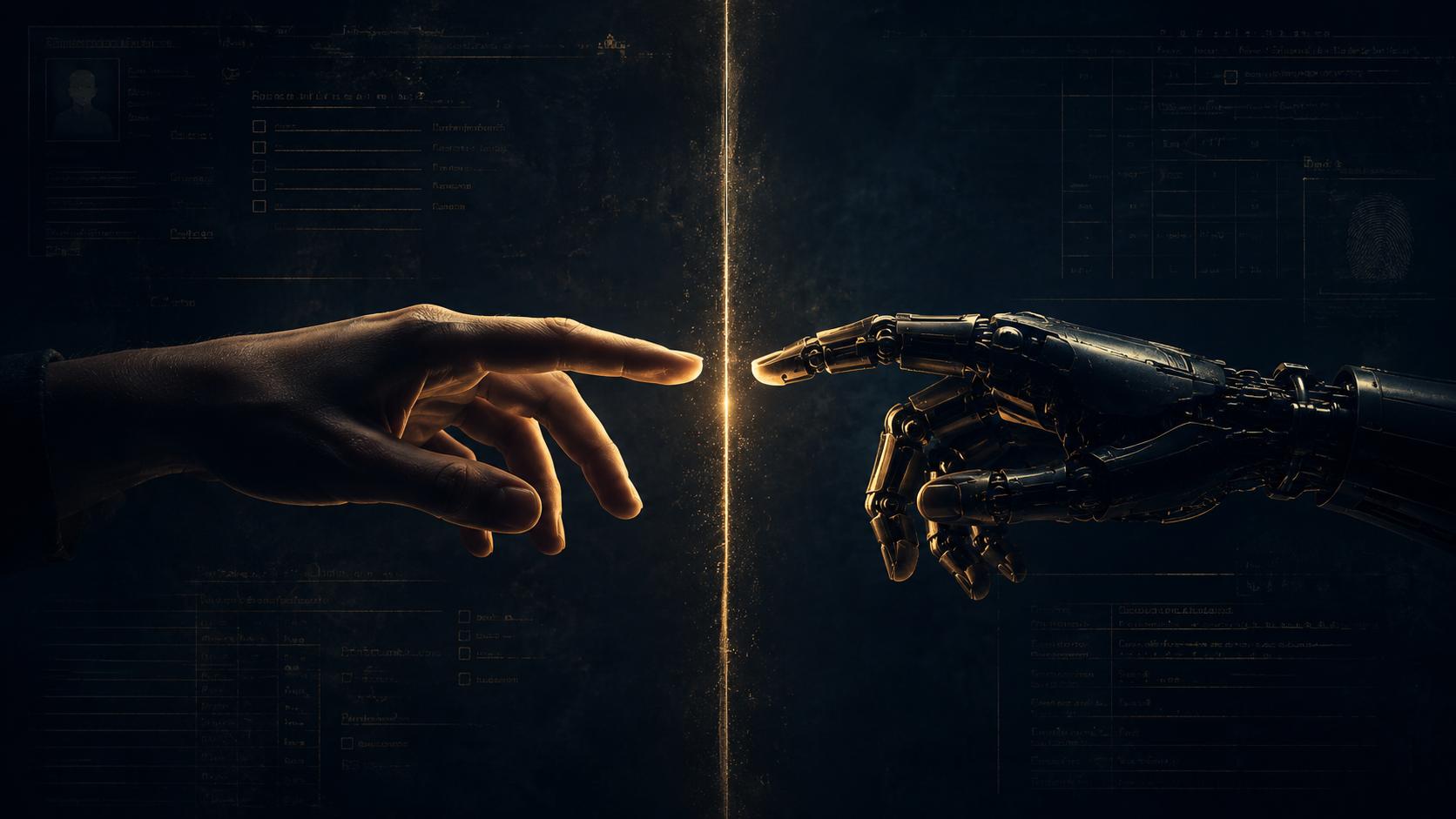
QUESTIONS IN THE FILE
Start with the question that moved the line.
WORD IN THE FILE
Robot
The modern term comes from the Czech word robota, associated with forced labor or compulsory service.
FOLLOW THE WORD →FILM NOTE
The Child at the Center
The official synopsis places a supposed world-ending weapon in the form of a young AI child.
OFFICIAL FILM PAGE →PATTERNS TO FOLLOW
The Mirror Has Receipts
These sources do not prove a single theory. They document why bias, classification, and human-centered safeguards belong in the file.
ODDITY IN THE FILE
The Excuse Machine
An AI tool now generates plausible excuses, adjustable believability levels, and follow-up storylines.
Not intelligence as calculator. Intelligence as social performance.
OPEN THE TOOL →QUICK ANSWER
What Is This File Asking?
The Creator is not only a story about humans fighting artificial intelligence. It is a story about what happens when intelligence, memory, loyalty, and feeling appear in a form humanity did not authorize.
The film opens a question older than machines: when a body is counted, copied, ranked, hunted, or replaced, what part is still considered human?
The real question is not whether a machine can become human. The sharper question is whether human beings can remain humane while deciding who does not count.
FILM CONTEXT
What Is The Creator Really Asking?
On the surface, The Creator is a future-war story: humans and artificial intelligence divided by fear, violence, and competing ideas of survival.
The official synopsis places an AI child at the center of the conflict. A supposed weapon is discovered in the form of a young child. The story works because the category becomes unstable: weapon or child, program or person, asset or soul.
The movie does not settle the argument. It makes the argument harder to avoid.
THE HUMAN SIDE
Definitions Land on People
Not every act of dehumanization begins with open cruelty. Sometimes it begins with a category, a form, a ranking system, or a rule that quietly decides whose pain counts first.
The language may sound neutral. The outcome rarely feels neutral to the person standing underneath it.
That is why the child at the center of the film matters. It is harder to treat a category as abstract when the category looks back.
History has repeatedly shown that a person can remain visibly human while being pushed legally, politically, or socially outside the circle of concern. The machinery changes. The distance it creates is familiar.
LANGUAGE DESK
The Word Before the Evidence
Once a category is accepted, almost anything can be placed inside it.
Enemy. Threat. Property. Tool. Defect. Other. Artificial.
A label can do something evidence cannot: prepare the room. It tells the audience how to feel before the details arrive.
The word does not complete the harm by itself. But it can make the next step easier to explain.
THE MIRROR
The Machine Does Not Arrive Empty
The easy version says artificial intelligence is dangerous because it may become too much like us.
The harder version asks what happens when it reflects us too clearly.
AI systems are built from human choices, human material, human definitions, and human priorities. NIST documents the importance of identifying and managing harmful bias in AI systems. That does not make every machine guilty. It makes the inputs worth examining.
The mirror is not the verdict. It is the invitation to look again.
ODDITY IN THE FILE: The category keeps widening. One public AI tool is built not to calculate or summarize, but to generate plausible excuses and supporting storylines. OPEN THE EXCUSE MACHINE →
PATTERN UNDER REVIEW
The Line Around Humanity
A definition can be useful. It can also become a border.
The pattern does not require every situation to be identical. It only asks the same question when classification begins doing more work than evidence.
Counted. Copied. Ranked. Removed.
The line matters most when someone else is standing outside it.
No verdict entered. The questions remain visible.
FIELD NOTES
What the Mirror Keeps
The question is not only whether artificial intelligence can become more human.
The harder question is what happens when human beings become more comfortable deciding who does not count.
Categories make difficult things easier to process. They turn uncertainty into labels, labels into policy, and policy into distance. From far enough away, the person disappears and only the designation remains.
That is why the machine matters.
Not because it arrives as something entirely foreign, but because it reflects the archive it was given: language, fear, hierarchy, desire, invention, cruelty, tenderness, contradiction.
The mirror is not the verdict.
It is the invitation to look again.
The line around humanity has never been fixed.
It has always been drawn by someone.
The question is who holds the pencil.
OPEN THE PATTERN INSTANCES
PATTERN INSTANCES
Three Places the Line Begins to Move
These are not accusations. They are recurring questions worth keeping visible.
PATTERN 01
The Word Before the Evidence
A charge becomes easier to believe once the vocabulary has already prepared the room.
PATTERN 02
Protection as Permission
A threat is declared. A response is justified. The boundary of acceptable harm can move quietly.
PATTERN 03
The Mirror Gets Accused
A tool may reflect the errors, appetites, incentives, and priorities of the people and systems using it.
OPEN QUESTIONS UNDER REVIEW
QUESTIONS UNDER REVIEW
Who Draws the Human Line?
No verdict entered. The questions are doing their job.
Classification
When does classification become permission?
Threat
What changes when a person is described as a threat before being treated as a person?
Copy
If intelligence can be copied, does personhood follow the copy?
Design
If a child is designed as a weapon, does the label erase the child or reveal the designer?
Responsibility
When a machine repeats a human bias, where does responsibility begin?
Empathy
What does empathy require when the category is uncertain?
Authority
Who gets to draw the human line?
Distance
Who usually stands outside it first?
OPEN THE SOURCE TRAIL
SOURCE TRAIL
Start with the Public Record
The film opens the question. The reference trail follows the pattern without pretending every case is the same.
Editorial note: This independent commentary is not affiliated with or endorsed by the film’s creators or distributor. Historical references are included as reference points for studying language, classification, and power. They are not presented as claims that every situation is equivalent.
BROWSE CONNECTED FILES
CONNECTED FILES
Follow Another Line
Different subjects. Recurring questions. The patterns emerge between the points.