
Public Decisions
The reality before the record
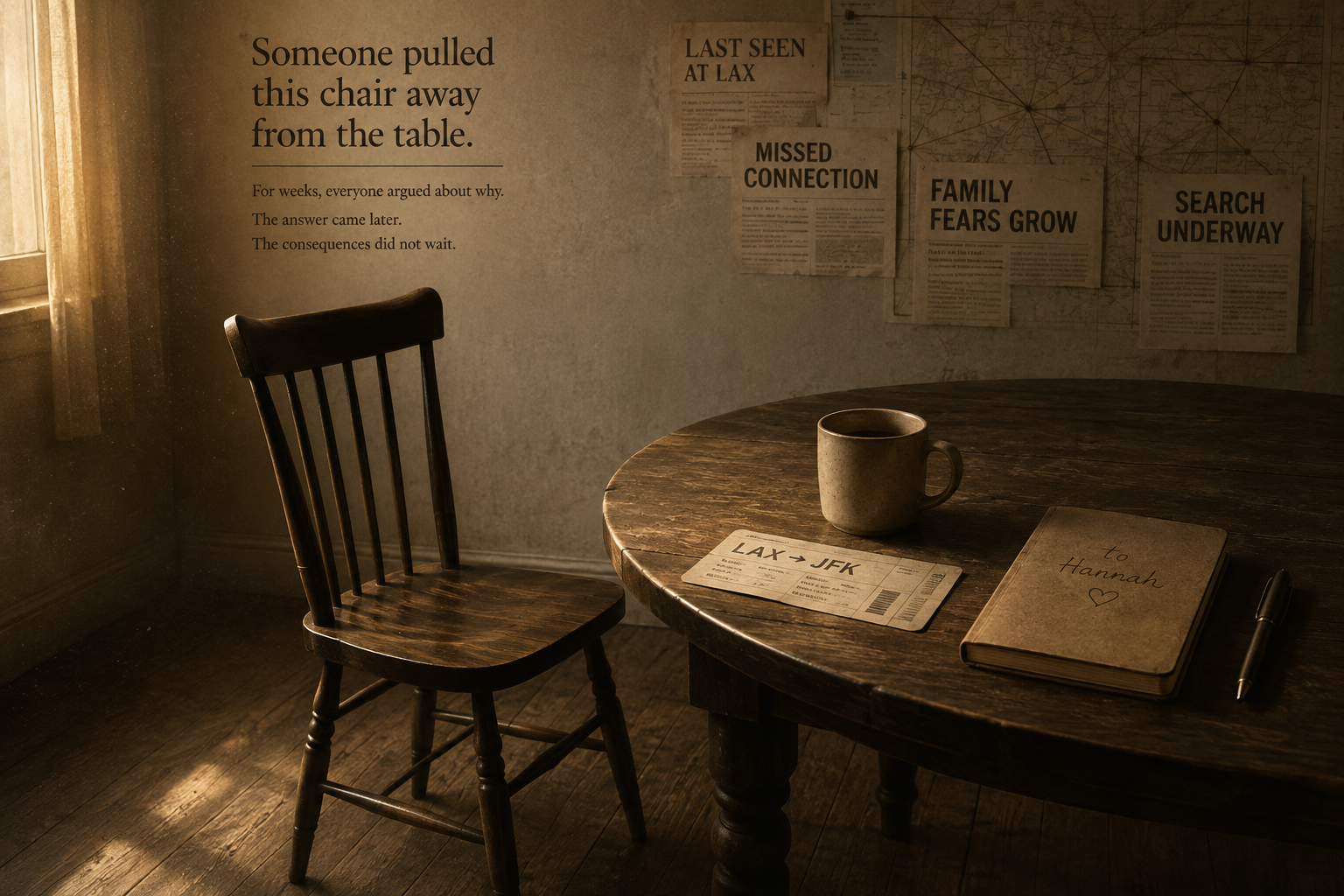
At first, there was only an empty seat.
A missed connection is ordinary until the next expected thing does not happen. A delayed reply is not yet danger. A strange message is not yet proof. At the beginning, each fact still belongs to several possible stories.
Then the hours change the weight of everything. The phone remains silent. A family begins testing one explanation after another. Concern becomes a search, and the search creates an audience.
When contact stopped, her family — represented publicly by her aunt, Larie Pidgeon — reported her missing.
Before investigators could establish the route Hannah Kobayashi had taken, the public was already being handed fragments: a missed flight, messages relatives found alarming, sightings in Los Angeles, silence, and fear.
The facts were incomplete. The demand for a complete story was not.
The last uncontested point
The route stopped making sense.
On November 8, 2024, Hannah Kobayashi arrived at Los Angeles International Airport from Maui. Her itinerary continued to New York, but she did not board the connecting flight. She remained in Los Angeles, and messages later received by relatives caused alarm. When contact stopped, her family reported her missing.
She had been booked on the same flight as her ex-boyfriend , a detail that would later shape how investigators, and the public, read everything that came after. At that point, the people searching for her did not know the route police would later assemble. They knew that the expected trip had broken apart and that someone they loved could not be reached.
What was known then
- She did not board the scheduled connection to New York.
- She remained in Los Angeles.
- Relatives described later messages as unusual and alarming.
- Her location and condition were unknown.
What the record later showed
- Police said they believed the missed connection was intentional.
- Border footage showed her entering Mexico alone on November 12.
- Police said she appeared unharmed and found no evidence of foul play.
- Her family later confirmed that she was safe.
Based on available opinion
The pieces arrived without their missing context.
Information did not arrive in the order required for understanding. A missed flight belonged to ordinary travel. Messages that frightened relatives changed its meaning. A sighting created hope and another question. Silence made every fragment heavier.
Each new piece appeared to complete the picture. Instead, it often erased part of the picture people had just finished building. A fact could be accurate and still be unable to explain the event around it.
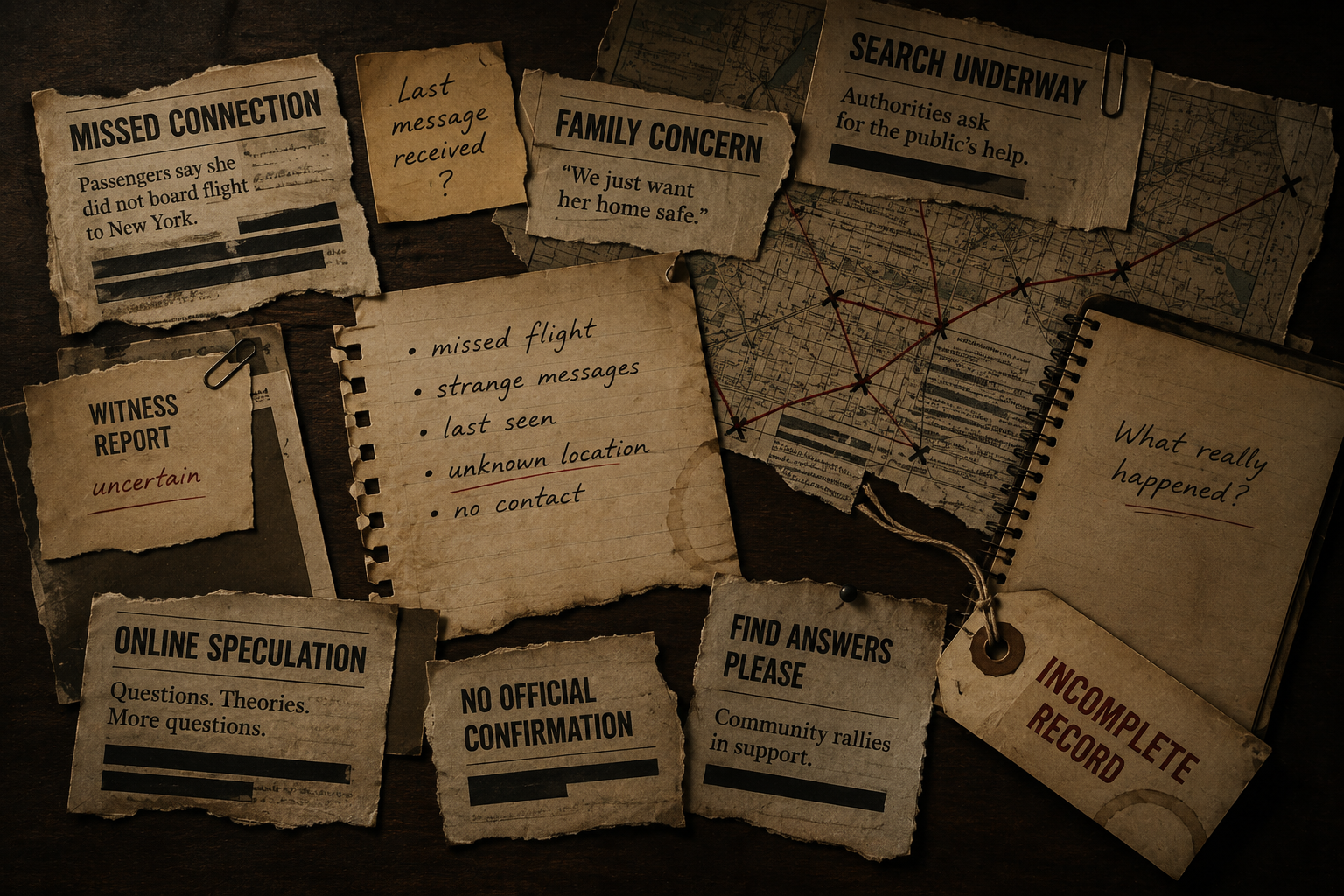
The family’s fear was not proof of abduction or trafficking. The later police account did not make that earlier fear dishonest. Each version was shaped by the information available, the authority of the speaker, and the human urge to make uncertainty stop.
Narrative control
Each new voice temporarily became the story.
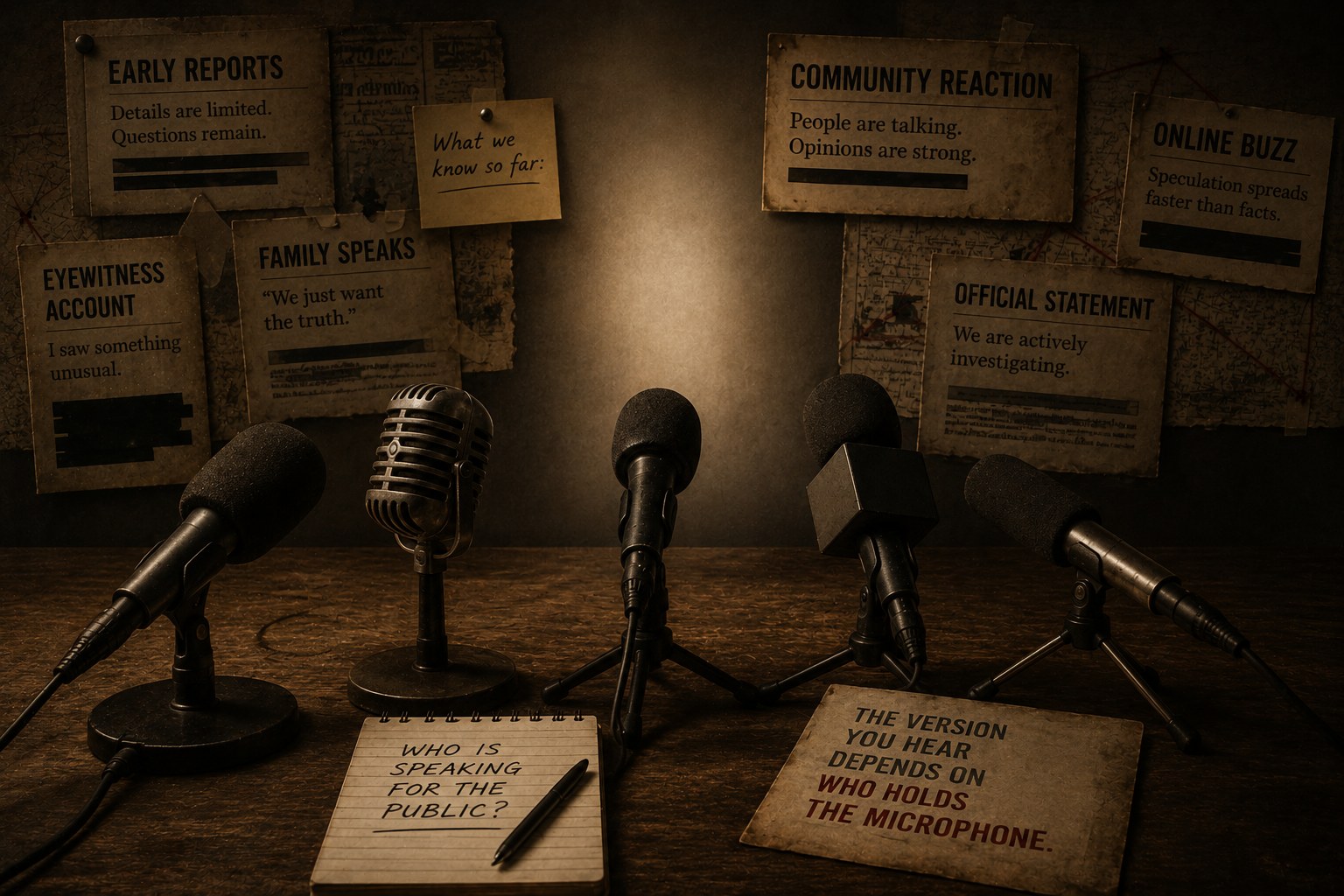
The public did not receive one stable account. It received a relay. Each speaker inherited an unfinished story, emphasized a different fragment, and changed what certainty sounded like.
A planned route had broken. Messages appeared abnormal to people who knew her. Contact stopped.
Whether another person controlled, threatened, manipulated, or harmed her.
Sightings, surveillance images, remembered interactions, and locations.
Whether an observed interaction was ordinary, coercive, protective, or unrelated.
Compressed days of uncertainty into headlines, summaries, repeated images, and breaking updates.
The difference between a fear, an attributed claim, a verified fact, and a question still open.
Border footage showed Hannah crossing into Mexico alone, carrying luggage, and apparently unharmed.
Her complete private reasoning, her experience while away, or how every earlier message should be interpreted.
Headlines, clips, fragments, timelines, comments, suspicion, sympathy, and hindsight.
That confidence is not evidence, and the people being judged cannot simply log out of the consequences.
The cost of the gap
Judgment traveled faster than confirmation.
Searching moved through airports, streets, phone calls, photographs, interviews, tips, and sleepless days. Public certainty moved at the speed of a refreshed screen.
Hannah’s father, Ryan Kobayashi, traveled to Los Angeles to help search for his daughter. He died during the search on November 24.
His death belongs to the human record of what happened, but not as a device for assigning a simple cause. The documented sequence does not justify turning grief into a neat accusation.
What can be said is smaller and harder: while strangers were trying to decide what the story meant, a family was still living inside it.
The record catches up
The answer arrived in stages.
Eventually, the pieces could be placed in an order that had not been available to the people living through them.
- The expected route broke. Hannah missed the scheduled connection from Los Angeles to New York and remained in Los Angeles.
- Concern became a public search. Her family reported her missing after unusual messages and lost contact.
- The official account changed. Police announced that border footage showed her entering Mexico alone and said they found no evidence of foul play.
- Her family confirmed she was safe. On December 11, the family announced that Hannah had been found safe and requested privacy while processing what had happened.
- She returned to the United States. In a statement shared by her aunt, Hannah said she was “unaware of everything happening in the media” during the weeks she was gone, and asked for space to focus on her healing, peace, and creativity.
What the record can actually tell us
Hannah was not shown to have been kidnapped or trafficked. Police said she traveled into Mexico alone and found no evidence of foul play. She was later confirmed safe and returned to the United States. The rest of her explanation belongs to her.
After the search
A safe return did not erase the public record.
The search ended publicly. Its consequences did not. Articles, clips, screenshots, theories, corrections, and judgments remained available beside one another, many carrying the certainty of the moment in which they were created.
Hannah returned.
Hannah returned. Pidgeon, still speaking on the family’s behalf, asked for privacy.
The investigation became a private matter. The audience moved on carrying whichever version had felt most convincing when it first appeared.Some factual questions were answered. A more difficult question remained: what happens to a person after strangers have spent weeks building explanations around an absence?
The public had followed a mystery.
The people inside it were left with a life.
Another story will arrive in fragments. Another temporary version will borrow the authority of fact.
The difficult sentence will still be:we do not know yet.
Sources & receipts
The record used for this article.
These sources document the changing public record: the search, the police account, confirmation that Hannah was safe, and her eventual return to the United States.
- Associated Press Police account of the border crossing and the classification of the case as a voluntary disappearance.
- Associated Press Confirmation that Hannah Kobayashi had been found safe.
- Los Angeles Times Reporting on how the official account changed after investigators reviewed border footage.
- Los Angeles Times Reporting on the end of the search and the family's request for privacy.
- Los Angeles Times Hannah Kobayashi's statement after returning to the United States.
- ABC7 Reporting on her safe return to the United States.